
 The acting world has their triple threat – 3 talents (acting, singing AND dancing) that are marks of greatness, and the science world has Dr. Holly Bik. She combines DNA lab work, computational biology, and science communications in the world of ocean science. (Personalized medicine and healthcare genomics, don’t be sad, but after 14 years of adoring you alone, now I also have a crush on Marine Biology.)
The Marriage of Evolutionary Biology & Dharma Yoga
by
The Scientific Talk Report Card
by
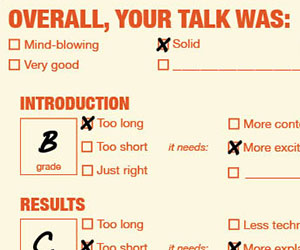 Colleague: “Hey, can you come to my practice talk later? I’d really like your feedback.”
You: (In your head: “I’d rather count the number of salt granules required to make a liter of Tris buffer.”) Uh, sure.
And just like that, you’re signed up to listen to an unpolished talk and provide the critical feedback that will hopefully right the ship. Worse, your colleague invited that windbag from the lab down the hall who lives to hear the sound of their own voice. If only there was some way to provide structure to the feedback process. If only…
Managing Publication Jealousy in the Lab
by
 Dear Dora,
I took over a nearly-completed project left behind by a grad student and my PI listed me as first author on the paper since I completed the project and wrote the manuscript. It is clear that several people in the lab resent the fact that I was given what they call an “easy paper” in my second year and now things are tense in lab. Is there anything I can do to ease the tension?
-Anonymous, grad student
Coitus Interruptus
by
 You know what would be really upsetting? Getting eaten while copulating. And, were you to copulate in the vicinity of a mighty predator, out in the open, your risk of getting fatally jiggy might be pretty high. Us humans generally (though not exclusively) avoid this by having sex in a house or hotel room, and our natural predators are few and far between. But what about all the other creatures on the planet?
Proper Interview Attire: Are Jeans Acceptable?
by
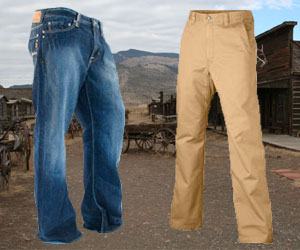 Last week, FlyGirl made the case for how to dress for an interview using two fashion icons, Magnum PI and Don Draper, to illustrate the point. The take home message is that – yes, even in academia – selecting proper interview attire is important. Whether we like it or not, our outfit is busy communicating with our potential employer long before we open our mouth – so let’s make sure it’s not sabotaging our interview.
How to Dress for an Interview: Don Draper vs. Magnum PI
by
 FlyGirl-
How do you dress for an interview without looking too overdressed or underdressed?
Cheers, Sam
My Postdoc Story: Start-Up Company Scientist, Anonymous
by
 While nearly all of us face challenges during our postdoctoral years, we often feel alone in our struggles. In this series, we hope to share encouraging and uplifting stories of how other scientists were able to turn their situation around and move forward, despite a non-ideal situation. Like snowflakes, fingerprints, and nightmares, every postdoctoral experience is unique, so today we share the Postdoc Story of another successful scientist.
Sun, Sand, and Damaged RNA
by
 Some of you might have noticed the irregularity of my Mind the Gap posts of late. But fear not, I’m back! I defended my PhD a couple of weeks ago after having only 3 weeks to finish writing the thesis, so things got a little crazy. Crazy awesome: I’m now Katie PhD, for real!
Debriefing the Lab After a Scientific Conference
by
 Dear Dora,
I will soon attend a TEM science workshop, and all the members of my lab are really impatient to have a perfect transmission of all the knowledge I can obtain in this workshop. I’m wondering if some users know some interesting tips or tricks to get the most out of this science workshop.
– Denis
Fun, Fast Workouts for Small Spaces (Like Labs!)
by
 Tired of your Lab Physique? Hunched over, head forward, shoulders slumped, eyes straining, butt widening, legs atrophying? Fight back! Rediscover the pleasure of moving your body. Don’t wait. Do it now.
