Communicating with Non-scientists: It’s a Ball or Tylenol?

Communicating Non-scientistsEffective communication is one of the most important skills required of a successful scientist.  We’re all accustomed to the process of writing papers, presenting data and giving talks among colleagues.  But once we leave the lab, things can get dicey.  Think of the dinner party where you’re the only scientist and someone asks “What do you do?”

A number of factors influence our experiences in communicating our work to non-scientists.  So to answer the question below, think about your average experience with the general public.  Returning to the dinner party situation, if scenario made you reach for the Rolaids, that should be a hint…

.

.

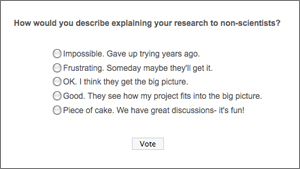
How would you describe explaining your research to non-scientists?

View Results

Loading ... Loading ...
      
        Share to Facebook                 Email This         More...    

5 comments so far. Join The Discussion

  1. psi*psi

    wrote on December 7, 2009 at 10:57 am

    Easy! "I make materials for solar cells and flat-screen displays. The technology we're working on lets us print these devices like you would a newspaper!"
    Plus, an instant way to friends with anyone eco-curious or gadget-inclined.

  2. dayman

    wrote on December 7, 2009 at 7:00 pm

    My entire explanation is 90% handwaving. I just hate talking about it because it inevitably leads to "when will you be done?" or "what are you going to do with that?" or, if I'm luck, both.

  3. 13columns

    wrote on December 9, 2009 at 7:33 pm

    exactly. you should always have one very high-level sentence about what you work on that you could tell anyone. the idea is not to blow them away with every detail right away- just to get the conversation started. if it's an interesting sentence, they'll want to ask more and you can slowly move into the details at a pace they're comfortable. took me many failed conversations to figure that one out…

  4. kfly

    wrote on December 10, 2009 at 3:56 pm

    Yeah but sometimes even your meaningful explanation can get lost on people. And by people this CAN be friends and family who you can't exactly try to lose in a crowded bar. I think the challenge comes from a sad state of how science is taught – some people, no matter how simple and elegant your explanation is, will glaze over at the first mention of "science" – they probably got feedback at an early age that they didn't excel or comprehend science or math "well enough" and from then on these subjects became life-long enemies. Science needs to be better at embracing kids who learn differently and reach analytical conclusions in more independent ways. Afterall if, as BenchFly has shown us, that succeeding in science has a lot to do with luck than why really can't we embrace people who tend to think more outside the box? It will only enrich the field and invite a wider range of bright people to explore scientific discovery.

    @psi-psi: that might be nice for you to have a project that you can relate to flat screen TVs, because even Joe 6 pack will appreciate that, but not everyone is doing a project like that. I think the key to explaining things to non-scientists is framing what you're working on in a way that reveals what part of it impacts them or the world the most.

  5. psi*psi

    wrote on December 11, 2009 at 7:44 am

    I disagree–13columns has it right. Application is important, but the key is to be enthusiastic and convey that you have the coolest job in the world and that your research is interesting and accessible–in the first three sentences. Once you're comfortable with the first three sentences, you will notice that people will start asking follow-up questions more frequently. Answering these requires you to think quickly on your feet, because they're not usually the sort of questions you hear from someone in your field. The key to answering them well is to avoid jargon, awkward pauses, and condescension…or you will lose your audience because those things convey an attitude of scientific elitism and will make your research seem esoteric. Having a cool project helps, but even if you're working on something more arcane it's still possible to get people interested, and they still walk away having learned something.

Leave a comment

will not be published

Sign Up for a Free Account Now 5 Things We Hate About Spam